





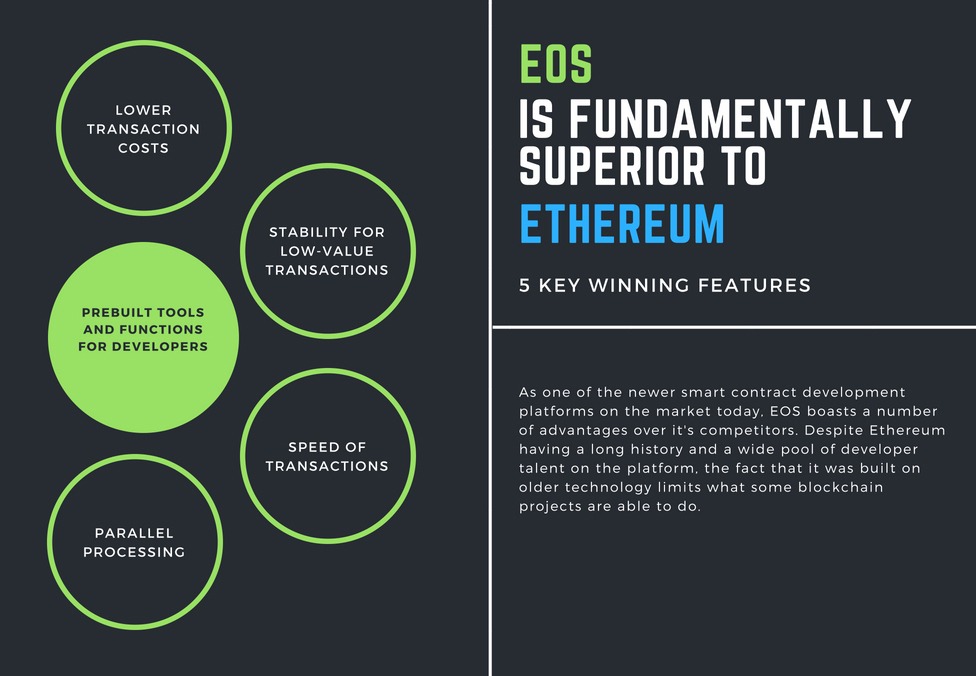
EOS is Fundamentally Superior to Ethereum – 5 Key Winning Features

Even though blockchain technology as a concept has been around for a few years already, there have been a few things that have prevented cryptocurrencies from truly becoming mainstream. One of them was solving the problem of how to automate agreements in the blockchain world. The solution would later come in the form of an innovative advancement now called smart contracts, coded algorithms that automatically control asset transfer between two (or more) parties when the predefined conditions are met.
Because of these advancements, parties can freely operate with each other in a decentralized ecosystem, making flexible agreements with each other without the involvement of a third-party intermediary. As you can imagine, it was smart contract technology that allowed for this explosion in blockchain start-ups, ICO’s, and the now booming demand for blockchain engineers.
A smart contract platform is a platform that supports developers in creating and executing smart contracts and building decentralized applications in general. The most prominent of which is Ethereum, and while the blockchain community at large remains reliant on this platform, new alternatives are springing up to challenge Ethereum’s dominance in the smart contract development scene. EOS, a new hyped platform which claims to be more efficient than Ethereum, is perhaps the most prominent challenger to Ethereum’s reign as the supreme platform for developers.
A Brief Overview of Ethereum and EOS
The brainchild of blockchain superstar Vitalik Buterin and launched in 2015, Ethereum is an open blockchain platform that lets developers build and execute smart contracts. In order for these developers to implement smart contracts on Ethereum, the platform has its own smart contract programming language called Solidity. Additionally, the platform uses proof-of-work (PoW) consensus algorithm and is planning to upgrade to proof-of-stake (PoS) in the near future.
Asides from being the leading smart contract development platform out there it also has its own cryptocurrency platform called Ether. This currency is used in the consensus verification process, also called “gas,” as a reward for the platforms miners who verified the transactions that occur on the platform.
EOS, on the other hand, uses a similar model as Ethereum albeit with some key differentiating factors. Founded by Daniel Larimar, head of Graphene Technology as the first developer that implemented the PoS algorithm, EOS makes it possible to process a larger number of transactions per second than Ethereum and also is known for being a lot more scalable than its Ethereum competitor. Since EOS is a newer project, they had the chance to take advantage of newer technological advancements that have been made in the crypto space.
While there is something to be said for the tried and true solution, many in the blockchain community are concluding that EOS is a fundamentally superior platform than Ethereum. Below you’ll find a few reasons why this is to be the case.
Speed of Transactions
The first reason why EOS proponents are championing this new platform is its superior transaction speed. EOS will have a block time of 0.5 seconds and touts that it’s able to support thousands, if not millions, of transactions per second (a feat that puts EOS in the league of international financial institutions such as Visa). In comparison, Ethereum to date has achieved maximum speeds of 50-100 transactions per second.
One of the reasons for this speed and security is Daniel Larimer’s unique Delegated Proof of Stake (DPoS) consensus algorithm, which he has been refining since 2013 and has successfully implemented in his previous blockchain projects – Bitshares and Steem. By using DPoS, EOS strives to solve the problem of mass scalability by letting network token holders cast votes in proportion to their stake in the network to elect 21 block producers. DPoS effectively democratizes the process by which parties are chosen to handle the “mining” aspect of the blockchain.
In theory, block producers are held accountable to the quality of their performance, and the competition between these producers to earn votes will incentivize increases in speed and scalability while creating a barrier for entry preventing hackers from hijacking the blockchain. It’s this principle that lets EOS boast superior transaction speeds as well as the added benefit of being highly secure, something that Ethereum’s overly complex sharding system can’t match.
Parallel Processing
As mentioned earlier, EOS was created after the proliferation of various blockchain platforms like Ethereum – which were largely experimental at the time. While every smart contract platform tries to lure in developers, those that were built on more dated technology struggle with the limit of what their programming architecture can permit.
Ethereum suffers from these limitations in transactional output because of a process called serialization, where transactions are limited to being processed sequentially. What this means is that transactions on the blockchain can’t be processed at once, or simultaneously, but instead must be processed in the order they were received.
The EOS platform recognizes this limitation and seeks to solve it by implementing asynchronous communication and parallel processing of transactions. Multiple transactions on the platform don’t need to wait their turn but can be immediately be processed together on a distributed network.
Many experts regard this innovation as a remarkable feat of transactional capacity and make Ethereum’s systems look antiquated by comparison.
Lower Transaction Costs
Developers that use Ethereum need to pay for various network fees for every transaction on their blockchain, using the platforms cryptocurrency Ether as a payment for the processing parties that confirm transactions on the block. In the past, this has created issues where ICO’s would fight over priority in the processing queue by offering larger sums of Ether to block processors to “bribe” them into giving them preferential treatment and leaving the less lucrative transactions to the bottom. Referred to as the “Ether Gas War” by members of the community, these transaction costs coupled with the sequential processing limitations of Ethereum can create roadblocks for some developers.
The EOS network is touted for having no fees. Instead, fees in EOS are paid through inflation, where 1% of the yearly inflation is distributed to the block creators on the network. This means that users don’t need to own any EOS tokens in order to use the application, making it easier for non-crypto people to get involved in the platform and accelerate its growth. Unlike Ethereum, which requires anyone that uses an ERC-20 token to pay a fee in Ether, which can be a hassle for the less technically inclined, EOS eliminates this point of hassle.
Stability for Low-Value Transactions
As mentioned above, low-value transactions have struggled to stay in priority during high volume requests. Coupled with the limitations to Ethereum’s technology (sequential processing) alongside the ability for developers to offer larger amounts of ether to guarantee that their requests get premium attention at the expense of the majority, this situation has created as “gas war” among the various competing ICO’s for attention.
EOS, thanks to how it compensates it’s block processors without having users fork over fees, ensures that the system can’t be rigged in favor of projects that have more ether to spend. What otherwise would be seen as low-value transactions according to Ethereum’s platform are seen as equal in the eyes of EOS. Just this alone does much to guarantee stability and reliability for developers, but when coupled with the parallel processing capabilities of the network, ensures that EOS is a fairer, impartial system for everyone involved.
Prebuilt Tools and Functions for Developers
All of the above-mentioned reasons help make EOS a highly desirable platform for developers. In light of this, the team has gone out of its way to develop specific tools for developers to make the platform more accessible. According to their developer’s website, “EOSIO is a free, open-source blockchain software protocol that provides developers and entrepreneurs with a platform on which to build, deploy and run high-performing decentralized applications.”
Developers can find a plethora of guides to help them get started on the platform, as well as a community to solve any problems they might find. While EOS at the moment still is a newer, next-generation platform, the various features mentioned above ensure that the platform will remain desirable and accessible to both developers and non-developers alike – growing the EOS community which further encourages the development of these tools.
Conclusion
Blockchain enthusiasts and developers alike are going to keep a close watch over the coming years as the various smart contract platforms compete among each other for dominance. While there are some proponents of other platforms, most people agree that EOS holds the most promise for dethroning Ethereum in the coming years as the go-to platform for blockchain developers.