
Pros and Cons of Using Hyperledger for Blockchain Applications

As the field of blockchain development continues to gain traction, many start-ups are looking to capitalize on this influx of talent through the creation of dedicated, decentralized application (dAPP) development platforms. Ethereum, the current reigning champion in this area, still retains an edge over the competition in terms of mainstream adoption. However, it does suffer from a slew of technical inadequacies that make it difficult for mass-adoption on the platform.
Instead, newer projects have entered the scene in an attempt to capitalize on Ethereum’s technological weaknesses, with one of the most notable being Hyperledger. A Linux Foundation Project, Hyperledger’s objective is to enable enterprises to develop blockchain-based applications quickly and easily. According to their website, the project describes itself as “an open source collaborative effort created to advance cross-industry blockchain technologies,” and has been described by some as a “hub for open, industrial blockchain development.”
A Primer on Hyperledger
The brainchild of several major IT companies such as IBM and Intel who saw the benefits of blockchain technology but didn’t want to restrict this field to just financial transactions, Hyperledger was the end result of this collaboration. By centralizing their software to the Hyperledger project and letting a non-profit organization, The Linux Foundation, manage it, these companies determined that this would be the best way to avoid redundantly wasting resources. Since being founded in December 2015 by 17 major companies, Hyperledger now boasts 130 members across the world and is the fastest growing project in the foundation’s history.
According to the Hyperledger website, the company lists five goals. Firstly, to create an enterprise-grade, open-sourced framework that supports business transactions. Secondly, to provide a neutral and open community-driven infrastructure. Thirdly, to foster the development of technical communities regarding DAPP development. Fourthly and fifthly respectively are aimed at educating the public about blockchain technology as well as promoting the community to the world as a viable answer to the growing blockchain awareness.
While all of these are commendable goals in and of themselves that many other projects strive to achieve, Hyperledger isn’t just a sole project. In reality, the Hyperledger umbrella encompasses five separate projects, Fabric, Sawtooth, Indy, Burrow, and Iroha. Although each project has its own goals, Fabric is Hyperledger’s most active project to date and tends to be what most developers refer to when mentioning Hyperledger.
Benefit 1: Modular Architecture
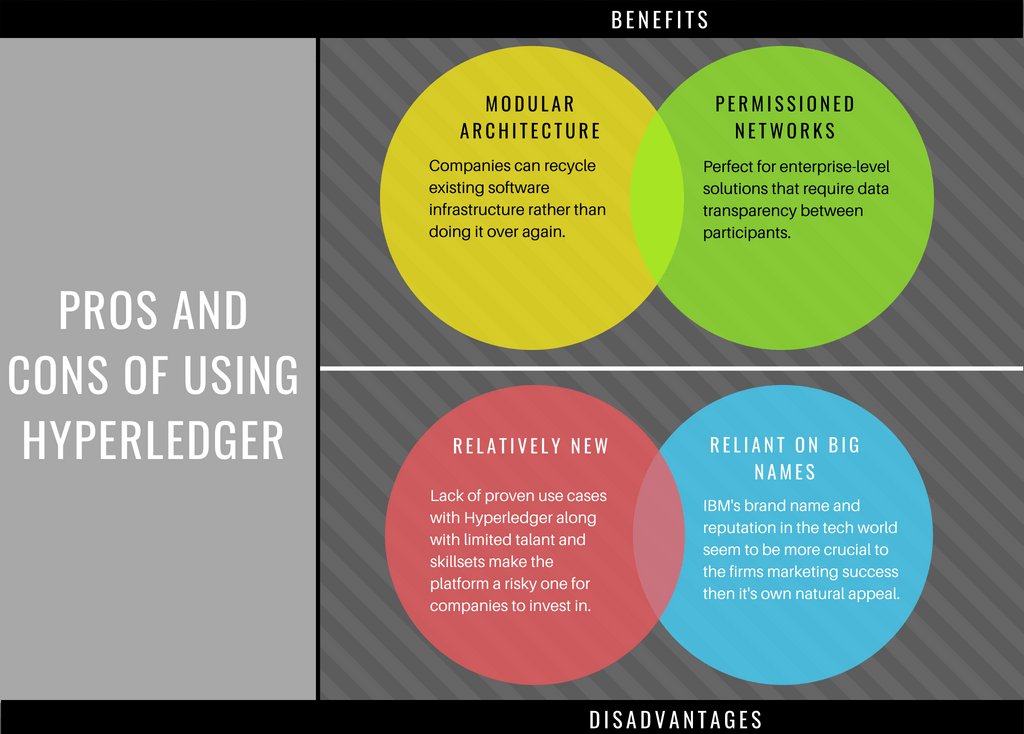
Among the biggest benefits of using Hyperledger for developing dAPP’s is its modular architecture. Fabric encourages developers to create integrating components that can be plugged into its architecture.
This kind of modularity is made possible by its robust architecture, offering a wide range of flexibility in terms of what developers can and can’t do. For example, one of the most requested areas in developer modularity is “bring your own identity.” Many multi-company networks already have an identity management system that they want to recycle rather than rebuild from scratch. Other areas that can easily be plugged into Hyperledger’s Fabric architecture include consensus and encryption, with even some countries having their own, specific encryption standards that need to be integrated into a project. Being able to save potentially hundreds of hours of effort by re-using these software components is highly desirable in the developer world.
Benefit 2: Permissioned Networks
Hyperledger’s Fabric is designed for permissioned networks. In the blockchain world, there is a distinction between permissioned and permissionless networks –which is closely related to the concept of public and private blockchains.
On a public blockchain, everything is visible. Anyone can read and write new blocks onto the chain, assuming they follow the rules. The most evident example of this is Bitcoin. Private blockchains, on the other hand, are invitation only. New nodes have to be validated either by the authenticators of the network or by a set of rules put into place. Private blockchains are best suited for blockchain apps dedicated for internal use in a single company.
Permissioned blockchains make transactions visible only to those who have permission to view them, not the whole network. This means that a transaction could be visible to a specific person or group, but not visible to the rest of the network – something that makes a lot of business sense. At the same time, permissioned networks mean that all participants have known identities, which can be important for applications that need to comply with data protection regulations. In many cases, such as the healthcare industry or the financial sector, applications are bound by data protection laws that require knowing the identities of those accessing a specific piece of information.
Between these two factors, Hyperledger boasts some impressive features when it comes to establishing permissioned networks on their platform. This makes sense, especially considering that Hyperledger markets itself mainly to enterprise level customers. Industries such as supply chain management, financial, healthcare, and many others could benefit greatly from these features.
Con 1: Relatively New
At the same time, there are a few disadvantages that hinder Hyperledger’s practicality and desirability for real-life use. Even though Fabric is the most mature of Hyperledger’s technology projects, it still has a long way to go before, with Fabric 1.0 having been just released in July 2017.
Many experts have cited this as being a major weakness for the platform. Saurabh Gupta, HFS Research’s chief strategy officer, summed it up best in saying that a “lack of proven use cases, limited understanding of technology and its potential, limited talent and skill-sets shortage across IT and business, etc.,” were major vulnerabilities for Hyperledger. “The inherent power and potential of the concept wit the help of some pioneering risk-takers will help pull it through such nascency challenges,” he added, but confirmed that “it will take time.”
Even many of Hyperledger senior staff acknowledge this newness to the market as being a big risk why some blockchain projects won’t adopt the platform. Brian Behlendorf, Hyperledger’s executive director, made a comparison in a Reuters interview that “if this were the web, what year would we be in? I’ve felt that we were in 1995, but with this release I am ready to say we are in 1996, when you started to see enterprises saying, ‘Now is not just a research project.’”
On the same vein, being so new to the market means that there are not as many developers skilled with working on the Hyperledger platform. This can make it difficult for companies to implement their solutions on the network as quickly as they would like.
Con 2: Reliant on Big Company Backing
While alternative platforms such as EOS and Stellar have started to become popular among blockchain developers, Hyperledger’s support seems to be strongly tied into it’s backing from major IT giants such as IBM, Intel, etc. While these big names carry weight in the tech industry, they are no substitute for what the rest of the blockchain development world thinks.
One expert on the topic is William Mougaya, Managing Partner and Chief Investment Officer at JM3 Capital. During one of his presentations on the state of Ethereum, he commented on the state of Hyperledger in comparison to the rest of the market;
“Hyperledger is backed by IBM, and IBM is a pro at productizing technology and marketing these products…and IBM is great at holding the market captive until they have the product together.”
Mougaya went on to add that of all the clients he’s spoken with, those that work on Hyperledger are also working with Ethereum in tandem, which is worth noting. Unlike other dAAP platforms that generate market interest naturally rather than relying on aggressive marketing, Hyperledger seems to rely quite strongly on IBM’s pull in the industry to maintain market interest.
Conclusion
While there is a strong undercurrent of hype behind Hyperledger, that doesn’t mean that it’s the perfect solution for one’s blockchain development needs. If you’re looking for a specific solution with enterprise partners, then Hyperledger might be the solution for you. However, there’s not enough indication that the market interest behind Hyperledger will be long term, and being at risk of getting locked into an ecosystem with limited non-enterprise appeal and few developers is a big risk for many to take.
Related Articles