

Is EOS Better Than Centralized Networks such as Stellar and Hyperledger?

In the post-Ethereum landscape that the next generation of blockchain enthusiasts claim to be coming, there are a few alternatives to the mainstream smart contract platforms. EOS, Stellar, Hyperledger, NEO, and a few others are clamoring for attention while claiming that they best address the technological shortcomings of the Ethereum platform. However, there remains a clear divide between what are essentially more centralized networks, such as Stellar and Hyperledger, and those that truly aim to be decentralized, such as EOS.
As blockchain experts would say, the current generation of smart contract development platforms suffers from several technological limitations that make them ill-suited to a blockchain-modernizing society. For one, Ethereum finds itself unable to handle many transactions. Even though the platform has both plenty of developers as well as having been around for a while, Ethereum can only process transaction requests sequentially, which slows down the process to where Ethereum only handles between 20-50 requests per second. This is a far cry from platforms that take advantage of newfound technological advances such as parallel processing, which lays the groundwork for a transaction speed per second in the thousands (if not millions).
At the same time, Ethereum’s gas prices create a situation where buying and selling ERC-20 tokens for more mainstream uses of the blockchain (which is what the industry hopes for in the future) will become ridiculously expensive. Imagine paying $2 dollars worth of fees for every time you want to upload some personal information, for example.
That’s why an alternative platform is necessary for the future expansion of the blockchain world, and there are many out there at the moment. Below we’ll look at a few of them.
The Cases For Centralization and Decentralization
Hyperledger, Stellar, and Neo are all examples of dAPP platforms that are fairly centralized, using “delegates” to witness and sign transactions on the blockchain. This contrasts with the “miners” of Bitcoin, which at first seems decentralized enough as individuals work for the sake of profit, the looming threat of a 51% majority means that there is always the possibility that the mining pool will quickly conglomerate into a centralized majority.
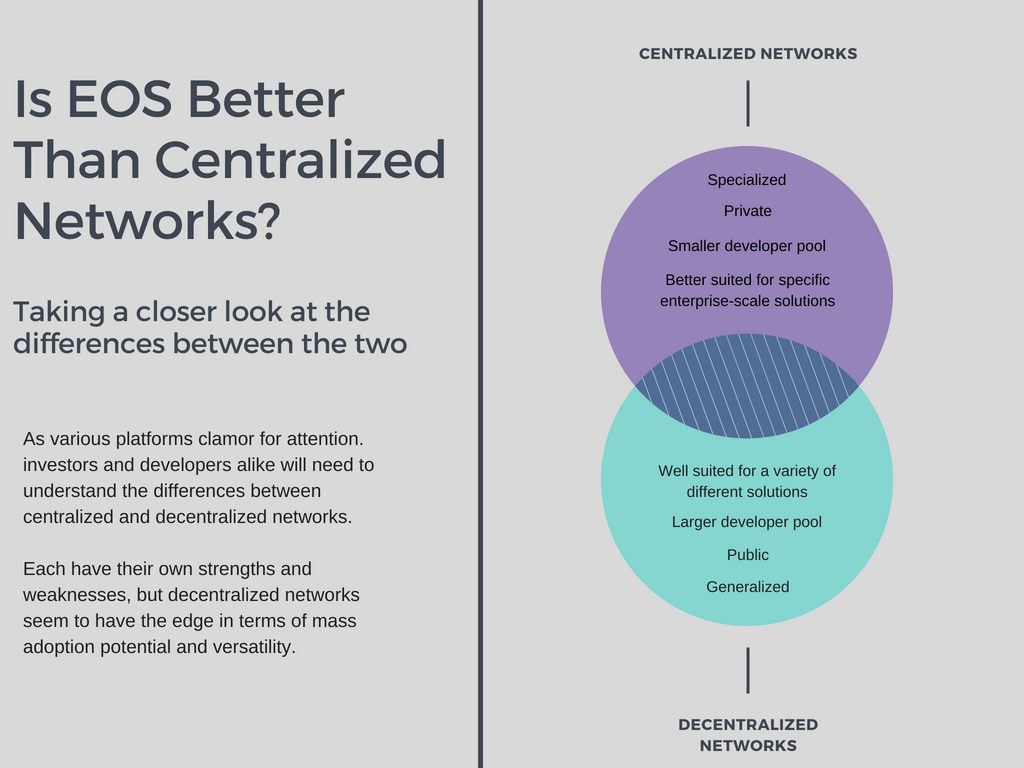
In contrast to what the more libertarian-minded blockchain enthusiasts would say, many in the community are fine with the idea of centralized solutions. However, centralized systems still have problems. For one, since there isn’t as much computing power securing a network as in the case of decentralized blockchains, centralized blockchains are less secure. All that’s required is for a few nodes hosting the network to collude in order to amass enough resources to compromise the network. At the same time, since private ledgers are not available for public use, there’s little value in using them unless you represent an enterprise level client for a specific solution.
Decentralized networks, on the other hand, are not only more secure and difficult to wrestle control over, but also promise to appeal to a wider market audience, making it more likely that these platforms will exist in the future. While enterprise-level clients might prefer Hyperledger for specialized tasks, for example, they won’t be as popular as decentralized networks, which have a broader appeal This in turn makes the platform more appealing as there is a greater number of developers/communities involved in that project.
Overview: Stellar
Stellar Lumens, which is referred to as simply “Stellar,” is a well-known crypto project focusing on payment processing and is in close competition with another crypto project called Ripple (of which Stellar forked from). Their team, just as in the case with Hyperleder, are backed by IBM – which already uses their technology for cross-border transactions. Having such a strong partner in the tech industry means that Stellar’s team can rely upon both the clout IBM carries in the sector as well as their own marketing efforts to support them.
While in Stellar’s case there is a genuine market need for cross-border payment systems, Stellar’s competitor Ripple is a significant competitor that questions whether the Stellar project is redundant in the first place. With the former being considerably more popular than the latter now, it also doesn’t help that Ripple’s team is larger and spread over multiple locations, in contrast to Stellar. Another problem of Stellar that its target market – enterprise level clients – prefer to have a centralized, stable cryptocurrency to do transactions with. While Stellar is more centralized then EOS, for instance, it’s less centralized then it’s competitor Ripple in comparison.
What this means is that Stellar, while a strong contender in the crypto industry, is facing an arguably uphill battle between its more popular counterpart, making it an uncertain platform for developers to latch onto in the future.
Overview: Hyperledger
Hyperledger is the result of many major IT companies pooling their blockchain-related brainpower together under the Linux Foundation banner. Their goal was to produce a platform that they hope will be the next big thing for enterprise-level decentralized application development.
There are a few distinct advantages to using Hyperledger, but it’s questionable whether or not the platform will truly become the next big thing in the market. Its chief benefits are its modular architecture that lets existing enterprise clients recycle their pre-designed systems (such as identification, encryption, consensus, etc.) rather than forcing them to recreate these programs from scratch. The platform also is designed with permissioned networks in mind, making it a good platform for clients that need to build semi-private blockchain applications on a more centralized framework.
However, as is the case with Stellar, Hyperledger is backed by IBM and relies on the tech giant’s reputation in the marketplace as well as it’s marketing teams to stir excitement in the community, something that some experts feel to be more “hype” rather than “substance.”
At the same time, Hyperledger doesn’t have a particularly long track record, with many clients that do choose to work with them also working with other platforms as well. This also ties into the risk of how Hyperledger could find itself turning into a more niche platform as other more universally desirable smart contract platforms grow and become more popular, eclipsing Hyperledger in the future.
Separate Overview: EOS
EOS takes a different approach than the other two platforms. Many experts argue that EOS is the closest project on the marketplace to becoming Ethereum’s successor. Dedicated to solving the technological inadequacies plaguing the mainstream platform, EOS has several innovations including parallel processing, faster transaction speeds (in the thousands), lower transaction costs, and a more stable platform for low-value transactions.
The last point is especially significant. While more private and centralized networks cater to larger, enterprise scale clients, small-scale blockchain projects can find themselves more at home on the EOS platform without worrying about fighting over premium gas prices for priority processing among Ethereum’s miners.
All of these things help make EOS much more accessible to developers and enable a wider range of applications to be built on it. Bitfinex, a cryptocurrency exchange, is just one of many upcoming companies that had announced earlier this year that they were building a new exchange built on top of EOS called EOSfinex. They went on to say that EOS’s fast transaction speeds, minimal fees, and other features made it the obvious choice. While EOS might not be as suitable for really specialized project needs, where it does shine is its versatility and the potential to become the next biggest thing in the marketplace.
Conclusion
To answer the question as to whether EOS is superior to more centralized platforms such as Hyperledger and Stellar, the answer depends. If you’re a large corporation looking for an enterprise-level solution or a specific blockchain solution, it’s possible that the first two platforms mentioned above could be more appealing. For the rest of the blockchain development world, however, EOS seems to be much more well rounded and versatile in its potential usage. Taking a more decentralized approach to building a smart contract development platform, while more challenging, certainly seems to be a superior philosophy for maximizing market adoption.