

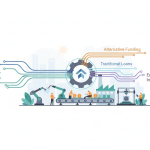
How RBF finance works for manufacturing and hardtech startups
Funding Structure Guide
Revenue Based Financing for Manufacturing Businesses
Revenue based financing (RBF) is a form of non-equity, non-debt capital in which a business receives a lump sum of funding in exchange for a percentage of ongoing gross revenues, repaid until a predetermined total amount has been returned to the investor or lender.
What is RBF
Revenue based financing provides businesses with upfront capital that is repaid as a fixed percentage of monthly or quarterly revenues, meaning repayment amounts fluctuate in line with the business's actual sales performance rather than following a fixed monthly instalment schedule.
For manufacturing businesses in particular, this structure is well suited to operations that experience seasonal demand cycles, project-based order flows, or variable production volumes, as slower trading months automatically result in lower repayment obligations without triggering a default event.
In an RBF arrangement, the business retains full ownership. There is no dilution of equity, no board representation granted to the capital provider, and no personal guarantee required in most standard facilities.
How it works
Eligibility criteria — manufacturing
Who qualifies for RBF
Most RBF providers underwrite facilities based on demonstrated revenue history rather than profitability, balance sheet strength, or asset ownership, making it accessible to manufacturers at earlier stages of growth than conventional lending typically allows.
Types of RBF funding for manufacturers
Funding structures and use cases
Revenue based financing is deployed across a range of operational needs within manufacturing businesses, from working capital and inventory purchase through to capital equipment acquisition and export order financing.
Comparative analysis
RBF compared to other funding structures
The table below compares revenue based financing across key dimensions against traditional bank lending, asset backed lending, and venture capital, each of which represents a common alternative funding pathway for manufacturing businesses seeking growth or working capital.
| Dimension | Revenue based financing | Traditional bank lending | Asset backed lending | Venture capital |
|---|---|---|---|---|
| Repayment structure | Variable monthly payments tied to a percentage of gross revenue; automatically adjusts to business performance | Fixed monthly principal and interest repayments regardless of trading conditions or revenue levels | Fixed or floating repayments secured against a specific asset; defaults may trigger asset seizure | No periodic repayment obligation; return generated via equity sale at exit event |
| Equity dilution | None. The business retains 100% ownership and all existing shareholder rights are preserved throughout the facility | None. Ownership structure is unaffected, though personal guarantees are commonly required | None. Ownership is unchanged, however specific assets may be legally encumbered during the loan term | Significant dilution. Investors receive equity stakes typically ranging from 15% to 40% per funding round |
| Collateral required | Generally none. Underwriting is based on revenue performance and future cash flow projections rather than asset ownership | Typically required. May include real property, plant, equipment, or personal assets of directors | Mandatory. The funded asset serves as the primary security for the facility | None. Investors accept equity risk in exchange for upside participation rather than asset security |
| Total cost of capital | Repayment cap is known upfront (1.2× to 2.5× of principal), though effective cost depends on how quickly revenue drives repayment | Determined by interest rate applied to outstanding balance; total cost is predictable if rates are fixed | Interest rates plus establishment fees; typically lower than unsecured lending given the security provided | No cash cost, however equity surrendered may represent a significantly higher economic cost at exit if business valuation grows substantially |
| Speed of access | 5 to 15 business days from application to funding in most cases, with minimal documentation requirements beyond revenue data | 4 to 16 weeks; subject to credit assessment, valuation of security, and internal approval processes | 2 to 8 weeks; dependent on asset valuation, legal searches, and registration of the security interest | 3 to 18 months; includes due diligence, term sheet negotiation, legal structuring, and investor syndication |
| Control & governance | No board representation, reporting covenants, or operational restrictions imposed by the capital provider | Financial covenants may restrict operational decisions during the loan term | Usage restrictions may apply to the funded asset; early termination penalties are common in equipment finance | Investors typically require board seats, information rights, approval rights over major decisions, and anti-dilution protections |
| Suitability for manufacturers | High. Particularly suited to businesses with variable revenue, seasonal orders, or project-based cash flows where fixed repayments create cash flow risk | Medium. Best suited to manufacturers with stable, predictable cash flows and sufficient assets or property to offer as security | High for asset-intensive operations. Ideal when funding specific equipment or using receivables as a debtor finance facility | Low for most manufacturers. VC is primarily oriented toward technology businesses with scalable, high-margin, software-driven revenue models |
Key terms and definitions
Common RBF terminology
Revenue based financing terms vary significantly between providers. Businesses should review the full repayment schedule, factor rate, any minimum revenue requirements, and prepayment conditions before entering into a facility. Independent financial or legal advice is recommended prior to execution.
Whether your a student, startup founder or investment banker build your skills and learn to design and maintain a range of financial models.
Build your capability to understand revenue drivers, sensitivity analysis, scenario modelling and backtest complex data.
Build upon Excel and Google Sheets and add time saving skills with AI agents, LLM and Pythnon techniques and apps for data crunching and automation of valuation models.