


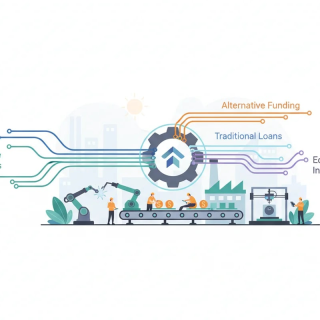

How Hardtech Ventures Can Use Asset-Based Financing to Scale Without Giving Up Equity
Raising capital in the hardtech sector has never been straightforward. Founders building physical products — whether advanced manufacturing equipment, robotics systems, or hardware-enabled platforms — face a funding landscape that often favors software-first businesses with faster growth curves and lower capital requirements. Venture capital remains available to the most compelling hardtech stories, but equity dilution at early stages can permanently reshape a founding team’s ownership and control. Asset-based financing offers a compelling alternative, one that is particularly well suited to the tangible, asset-rich nature of hardtech businesses.
Understanding Asset-Based Financing
Asset-based financing, often referred to as asset-based lending or ABL, is a method of securing working capital by pledging a company’s tangible assets as collateral. Those assets typically include accounts receivable, inventory, equipment, and real estate. Rather than evaluating a company primarily on its earnings history or projected growth, lenders assess the underlying value of what the business actually owns or is owed. This distinction matters enormously for hardtech founders, whose balance sheets frequently carry significant physical assets long before the income statement tells a flattering story.
Compared to traditional term loans, which rely heavily on creditworthiness and historical cash flow, asset-based lending is more accessible to businesses in growth or transition phases. Compared to equity financing, it preserves ownership entirely. The trade-off is that lenders take a security interest in the pledged assets, and they typically require ongoing reporting and monitoring to ensure the collateral retains its value throughout the loan term.
The asset-based lending market has grown substantially in recent years, reaching $896.12 billion globally in 2025, up from $785.6 billion in 2024, representing a compound annual growth rate of 14.1%. Syndicated ABL volume reached $24.3 billion in the third quarter of 2025 alone, a 12% increase quarter over quarter, while factoring volume grew 16.6% year over year. These figures reflect a broad and deepening market that hardtech founders are increasingly well positioned to access.
How the Mechanics Work in Practice
The process begins with a collateral assessment. A lender will appraise the value of the assets a company intends to pledge and then offer a loan amount calculated as a percentage of that appraised value. The advance rate varies by asset type, reflecting the lender’s view of how quickly and reliably each asset class can be converted to cash if the borrower defaults.
Accounts receivable typically attract the highest advance rates, often in the range of 70 to 85 percent of eligible receivables, because they represent near-term cash that is already owed to the business. Inventory is treated more conservatively, with advance rates commonly in the range of 40 to 60 percent, reflecting the time and cost required to liquidate physical stock. Equipment and real estate can also serve as collateral, though valuations depend heavily on the asset’s age, condition, and market demand.
To illustrate the mechanics with a concrete example, consider a hardtech startup that has $5 million in accounts receivable and $3 million in inventory on its balance sheet. A lender offering an 80 percent advance rate on receivables would extend $4 million against that asset class. Applying a 50 percent advance rate to the inventory would yield an additional $1.5 million. The combined borrowing base would therefore support a total loan of $5.5 million. Repayment terms would be structured around the company’s cash flow projections, with monthly payments over a defined term and interest rates calibrated to the perceived risk and quality of the underlying collateral.
This structure means the available credit is dynamic. As receivables are collected and new ones are generated, and as inventory levels fluctuate with production cycles, the borrowing base adjusts accordingly. For a growing hardtech company, this creates a financing facility that scales naturally alongside the business.
Why Hardtech Businesses Are Particularly Well Suited
The capital-intensive nature of hardtech development creates exactly the kind of balance sheet that asset-based lenders find attractive. Manufacturing equipment, production tooling, component inventory, and customer receivables are all assets that can be pledged, and they tend to accumulate in volume as a hardtech company moves from prototype to production scale. A software company may have little to offer a secured lender beyond intellectual property, which is difficult to value and harder to liquidate. A hardtech company building industrial systems or consumer hardware has a fundamentally different asset profile.
During scaling phases in particular, asset-based financing can bridge the gap between growing demand and the working capital needed to fulfill it. A company that has won significant new contracts but lacks the cash to purchase materials and ramp production can use its receivables and inventory to unlock capital without waiting for equity rounds or diluting existing shareholders.
Case Studies from the Field
Ooodles, a UK-based Hardware-as-a-Service provider that rents technology equipment to businesses, secured a $12 million investment package that included a $4 million asset-backed facility. The non-dilutive nature of the asset-backed component was central to the company’s strategy, allowing it to meet rising customer demand and expand its platform without surrendering equity at a stage when ownership was particularly valuable. The physical assets underlying Ooodles’ rental fleet provided the collateral base that made the facility possible.
In a different context, an asset-light industrial services equipment installer secured a $3.3 million SBA loan for working capital despite not possessing the kind of heavy physical asset base that typically underpins ABL structures. The company leveraged specific SBA provisions to access financing, demonstrating that the principles of asset-based and government-backed lending can be applied flexibly across a range of business models within the broader industrial and hardtech space.
Risks Worth Understanding
Asset-based financing is not without its complications. Assets used as collateral can depreciate, and if the value of pledged equipment or inventory falls materially, lenders may reduce the borrowing base or trigger covenant requirements that demand partial repayment. The ongoing monitoring obligations are also meaningful — lenders typically require regular audits and detailed reporting on collateral status, which places administrative demands on management teams that may already be stretched.
There is also the risk of overleveraging. A company that draws heavily on its asset base during a growth phase may find itself exposed if revenue growth stalls or cash conversion cycles lengthen. Repayment obligations are real and recurring, and a deteriorating cash flow position can quickly become a structural problem if the debt load is not carefully managed.
For hardtech founders who understand these dynamics and manage them proactively, asset-based financing represents one of the most powerful tools available for scaling a capital-intensive business while preserving the equity that reflects years of technical and commercial work.