


Revenue-Based Financing: A Practical Guide for Manufacturing Startups
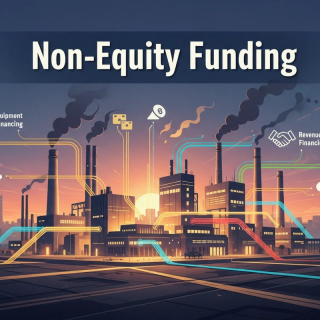
Manufacturing startups face a distinctive set of funding challenges that set them apart from software or service businesses. Capital requirements arrive early and in large amounts, whether for tooling, equipment, inventory, or production capacity, while revenues often take time to reach the scale needed to satisfy traditional lenders. Equity investors, meanwhile, expect meaningful ownership stakes in return for the risk they absorb. For founders who have spent years building proprietary processes or product lines, giving away equity at an early stage can feel like a poor trade. Revenue-based financing has emerged as a compelling middle path, and its rapid growth suggests that more operators are reaching the same conclusion.
How Revenue-Based Financing Works
Revenue-based financing, commonly abbreviated as RBF, is a funding model in which an investor provides a lump sum of capital to a business in exchange for a fixed percentage of that business’s ongoing gross revenues until a predetermined total repayment amount has been reached. Unlike a bank loan, there is no fixed monthly payment that must be met regardless of trading conditions. Unlike an equity round, there is no transfer of ownership. The investor is repaid faster when revenues are strong and more slowly when revenues dip, which means the repayment schedule bends naturally around the operating rhythm of the business.
Typical repayment caps range from 1.3 times to 2.5 times the original funding amount, and the monthly revenue share taken by the investor generally falls between two and ten percent of gross revenue. A manufacturer generating $200,000 per month in revenue who agrees to a five percent revenue share would remit $10,000 per month until the cap is reached. If revenues grow to $300,000 per month, the monthly payment rises to $15,000 and the facility is retired more quickly. If revenues fall to $150,000 during a slow quarter, the payment drops to $7,500 without any default or renegotiation required.
Why Manufacturing Startups Are Well Suited to This Model
Manufacturing businesses with consistent or growing revenue streams are natural candidates for RBF because the model rewards exactly the kind of asset-heavy, revenue-generating activity that defines the sector. A company that has invested in equipment and built a customer base has the revenue history that RBF providers look for. Some providers report approval rates exceeding 80 percent for applicants who meet baseline criteria, which typically include a minimum monthly revenue of around $30,000 and at least twelve months of operating history.
The preservation of equity is perhaps the most immediate advantage for founders. Retaining full ownership means retaining full control over strategic decisions, future fundraising terms, and the eventual exit value of the business. Flexible repayment structures also ease cash flow management during the seasonal or cyclical downturns that are common in manufacturing, where a large order might land in one quarter and the pipeline might be thin in the next. Because the investor’s return is tied directly to the company’s revenue performance, there is also a genuine alignment of interests that is sometimes absent in more adversarial debt arrangements.
Case Studies in Practice
Klarinet Solutions, a technology services business that worked with Founders First Capital Partners, used revenue-based financing to fund the expansion of its digital product lines without diluting the founding team’s ownership. The capital allowed the company to invest in growth initiatives that would have been difficult to pursue under the constraints of traditional debt, and the flexible repayment structure meant that the business could service the facility from the revenue that the new products generated. The case illustrates a pattern that applies equally well to manufacturing contexts: RBF works best when the capital is deployed into activities that directly expand the revenue base from which repayments are drawn.
TYR Tactical, a manufacturer of body armor and tactical equipment, financed a $3.5 million press machine through specialized equipment financing, a closely related form of asset-linked funding. The investment in production capacity allowed the company to take on larger contracts and improve throughput without surrendering equity to achieve it. While the specific instrument differed from a pure revenue share arrangement, the underlying logic is the same: capital tied to the productive capacity of the business, repaid from the revenues that capacity generates.
A Worked Financial Example
Consider a hypothetical precision components manufacturer that has been operating for two years, generating $150,000 per month in gross revenue and seeking $500,000 to purchase a CNC machining center that will allow it to bring a previously outsourced process in-house. The company secures RBF at a 1.8 times repayment cap, meaning the total amount to be repaid is $900,000. The revenue share is set at six percent of monthly gross revenue.
In the base case, where revenue stays flat at $150,000 per month, the monthly payment is $9,000 and the facility is retired in exactly 100 months, or just over eight years. That is a long tail, and it illustrates why RBF works best when the funded investment is expected to accelerate revenue growth rather than simply maintain current output.
In the growth case, the new machining center allows the company to eliminate outsourcing costs and take on additional contracts, lifting monthly revenue to $250,000 within twelve months. At that level, the monthly payment rises to $15,000 and the remaining balance is retired in roughly 50 months from the point of revenue increase, bringing the total facility duration to around five years. The total cost of capital is $900,000 against an original advance of $500,000, which equates to an effective return of 80 percent for the investor and a cost of $400,000 for the founder, spread over the life of the facility without any equity transfer.
Considerations and Potential Drawbacks
RBF is not without its complications. Research analyzing transaction-level data from a South African payment platform found that businesses using RBF processed approximately 16 percent less revenue through the platform after eight months compared to similar businesses that did not use the facility. The study raised concerns about revenue diversion and adverse selection, which can slow repayment and create friction between founders and investors. Founders considering RBF should be aware that providers will scrutinize revenue consistency carefully and that any behavior that appears to route revenue away from the tracked accounts is likely to damage the relationship and the terms of future facilities.
The cost comparison with traditional debt is also worth examining honestly. A bank term loan at a seven percent annual interest rate on $500,000 over five years would result in total interest payments of roughly $93,000, a fraction of the $400,000 cost in the RBF example above. The premium paid for RBF reflects the flexibility, the absence of collateral requirements, and the non-dilutive nature of the instrument, but founders should model both options carefully before committing.
Choosing the Right Path
Revenue-based financing occupies a genuinely useful position in the funding landscape for manufacturing startups. It is most powerful when deployed by businesses that have established revenue, a clear use of proceeds that will expand that revenue, and a preference for retaining ownership over minimizing the total cost of capital. The RBF market grew from $2.8 billion in 2020 to $9.8 billion in 2025 and is projected to reach $67 billion by 2029, a trajectory that reflects real demand from founders who find the trade-offs favorable.
For manufacturing operators evaluating their options, the practical starting point is a clear-eyed assessment of current monthly revenue, projected revenue growth from the intended investment, and the total repayment obligation under realistic scenarios. If the numbers support a facility that is retired within three to five years on the back of genuine revenue growth, revenue-based financing deserves serious consideration as a way to fund the next stage of the business without giving away a piece of it.