



How Non-Equity Funding Is Reshaping Growth in Manufacturing Ventures
For founders building manufacturing businesses, the question of how to fund growth is rarely straightforward. Equity financing has long been the default narrative in startup culture, but it comes with a cost that many operators are increasingly reluctant to pay: ownership dilution and the loss of strategic control. Non-equity funding offers a compelling alternative, providing capital through mechanisms that leave the cap table intact. As manufacturing ventures face the dual pressure of capital-intensive operations and competitive markets, understanding the full landscape of non-equity funding has become a practical necessity rather than an optional consideration.
Understanding Non-Equity Funding
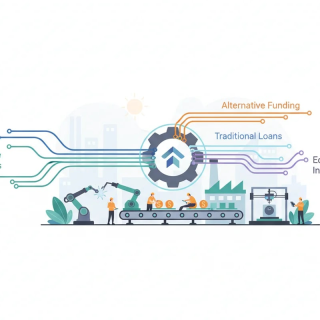
Non-equity funding refers to any financing arrangement that provides capital without requiring the business owner to surrender an ownership stake. In the manufacturing context, this category encompasses three primary instruments: revenue-based financing, grants, and loans. Each carries a distinct risk and repayment profile, and each suits different stages of business development and operational need.
Revenue-Based Financing operates on a straightforward principle. An investor provides a lump sum of capital, and the business repays that capital as a fixed percentage of its monthly revenues until a predetermined total amount has been returned. Because repayments scale with revenue, the model is particularly well-suited to manufacturing businesses that experience seasonal fluctuations or lumpy order cycles. In a strong month, repayments are higher; in a slower period, they fall accordingly. This dynamic alignment between cash outflow and cash inflow reduces the liquidity risk that fixed-schedule loan repayments can create.
Grants represent non-repayable funding awarded by government agencies, non-profit organizations, or corporate programs to support specific activities such as research and development, workforce training, or technology adoption. For manufacturing startups, grants can be transformative precisely because they carry no repayment obligation. The trade-off is that grant programs are competitive, often narrowly scoped, and require significant administrative effort to apply for and report on. However, when a grant aligns with a company’s existing roadmap, it can effectively subsidize activities that would otherwise consume operating capital.
Loans, whether secured against assets or extended on an unsecured basis, remain the most widely used form of non-equity funding for manufacturers. Asset-based lending, a subset of secured lending, allows businesses to borrow against the value of receivables, inventory, or equipment. This structure is particularly relevant in manufacturing, where physical assets are abundant and can serve as collateral to unlock meaningful credit facilities.
Strategic Use of Non-Equity Funding to Scale Operations
The most effective use of non-equity funding is not reactive but strategic. Founders who treat these instruments as a toolkit rather than a last resort are better positioned to sequence their funding in ways that preserve optionality and minimize cost of capital over time.
A common approach among scaling manufacturers is to layer funding types according to the nature of the expenditure. Grants are best deployed toward innovation and R&D activities where the output is uncertain and the investment would be difficult to justify on purely commercial terms. Loans and asset-based credit facilities are well-suited to financing equipment purchases, inventory builds, and facility expansions where the asset itself provides security and the return on investment is relatively predictable. Revenue-based financing sits in the middle, offering flexible capital for working capital needs, sales and marketing investment, or operational scaling where revenue generation is already established but growth requires additional fuel.
This layered approach also has the benefit of reducing dependence on any single funding source, which is important in an environment where grant programs can be discontinued and credit markets can tighten.
Success Stories from the Manufacturing Sector
The Fresh Factory, a food manufacturing business, provides a clear illustration of how asset-based lending can unlock operational scale. By working with Mitsubishi HC Capital America on an asset-based lending arrangement, the company was able to improve its liquidity position and expand production capacity without surrendering equity. The structure allowed the business to borrow against its existing assets, converting balance sheet strength into working capital that could be deployed immediately into operations.
Polybound, a manufacturing business that supplies materials to industrial customers, used trade finance through Treyd to triple its revenue. The funding allowed the company to fulfill larger orders without being constrained by the cash flow gap between paying suppliers and receiving customer payments. This is a challenge endemic to manufacturing, where production cycles mean that cash is tied up in inventory and work-in-progress for extended periods before it converts back into receivables and eventually cash. By bridging that gap with non-equity financing, Polybound was able to take on contracts that would otherwise have been beyond its financial reach.
These examples share a common thread: the businesses used non-equity funding to solve a specific operational constraint rather than simply adding capital to the balance sheet. That precision of purpose is what separates effective use of these instruments from the kind of undisciplined borrowing that can create long-term financial stress.
Financial Metrics That Demonstrate the Impact
The quantitative case for non-equity funding in manufacturing is supported by research from Statistics Canada, which examined the impact of federal business support programs on manufacturing enterprises over a three-year period. Businesses that received government support for innovation and growth recorded average employment growth of 1.8% per year, while non-beneficiary enterprises experienced employment declines over the same period. The supported businesses also reported stronger revenue growth compared to their unsupported peers, suggesting that targeted capital injection has a measurable and sustained effect on business performance.
At a larger scale, the flexibility of revenue-based financing has been demonstrated in high-growth contexts. In 2025, a fintech business secured $100 million through revenue-based financing to fund global expansion, illustrating that the instrument is not limited to small or early-stage businesses but can be structured to support substantial capital requirements when the revenue base is sufficient to support repayment.
Challenges and Honest Considerations
Non-equity funding is not without its complications, and founders should approach these instruments with clear-eyed awareness of the risks involved. The most significant concern with revenue-based financing and loans is the debt obligation itself. If revenue projections are not met, repayment schedules can strain cash flow and create operational pressure at precisely the moment when the business needs flexibility. This risk is amplified in manufacturing, where margins can be thin and revenue can be disrupted by supply chain issues, customer concentration, or production delays.
Grants, while attractive in principle, are highly competitive and often limited in scope. Many programs target specific industries, geographies, or types of activity, which means that not every manufacturing business will qualify. The application process can also be resource-intensive, requiring detailed documentation and ongoing reporting that diverts management attention from operations.
It is also worth acknowledging what non-equity funding does not provide. Equity investors, particularly those with deep sector expertise, can bring strategic value that goes beyond capital. Industry networks, customer introductions, operational guidance, and board-level support are contributions that a lender or grant program cannot replicate. For some manufacturing businesses, particularly those navigating complex markets or requiring significant strategic repositioning, equity financing may still be the more appropriate choice despite the dilution it entails.
Practical Advice for Manufacturing Entrepreneurs
Founders evaluating non-equity funding should begin with a clear assessment of what the capital is intended to achieve. Equipment purchases, inventory financing, and receivables management are natural fits for asset-based lending. Working capital needs tied to revenue growth are well-suited to revenue-based financing. Research, development, and technology adoption may qualify for grant funding, particularly where government programs exist to support manufacturing innovation.
Before committing to any financing arrangement, it is worth modeling the repayment obligations against realistic revenue scenarios, including downside cases. For revenue-based financing, understanding the total repayment cap and the percentage of revenue committed is essential to ensuring that the arrangement does not create a cash flow constraint that undermines the very growth it is intended to fund.
Building relationships with lenders and funding providers before capital is urgently needed is also advisable. Lenders assess creditworthiness and business quality, and a business that approaches a financing conversation from a position of stability rather than desperation is more likely to secure favorable terms.
Finally, founders should not overlook the cumulative effect of combining funding sources. A grant that covers R&D costs reduces the amount that needs to be borrowed or financed through revenue-based arrangements, lowering the overall cost of capital and preserving more of the business’s cash flow for reinvestment.
Conclusion
Non-equity funding has matured into a sophisticated and genuinely useful toolkit for manufacturing ventures seeking to grow without giving up ownership. Revenue-based financing, grants, and loans each address different capital needs and carry different risk profiles, but used strategically and in combination, they can provide the fuel for meaningful operational scaling. The evidence from both individual case studies and broader research suggests that businesses that access these instruments thoughtfully and deploy them with precision do grow faster and hire more people than those that do not. For manufacturing entrepreneurs who want to build substantial businesses on their own terms, non-equity funding deserves serious and sustained attention.